

When it comes to components of substances found in natures bounty few are as fascinating and flexible, as Gum Acacia Powder and mastic gum. Two tree derived gems, with distinct origins and uses that set them apart from each other significantly! Follow along as this blog delves into the realm of these two resins. Delving into their characteristics while shedding light onto their significance and contemporary uses. Whether you're someone who loves cooking or enjoys exploring remedies or just intrigued by the beauty of nature – knowing the differences, between gum and mastic gum can introduce you to a world of exciting prospects! Lets explore the captivating history behind these age resins and unravel how they still shape our experiences today.
Basic introduction of two types of gum materials
● Arabic Gum
Arabic Gum, also known as gum arabic powder, is a natural gum-like substance secreted from trees such as Acacia senegal and Acacia seyal. The "Arabic" in its name comes from the fact that this gum is mainly produced in the Arabian region and some specific areas in Africa. Gum arabic is widely used in many fields such as food, medicine, and cosmetics. It is a natural emulsifier, stabilizer, and thickener. In the food industry, it is often used in soft drinks, candies, dairy products, etc. to improve the texture and taste of the products.
● Mastic Gum
The Chinese name of Mastic Gum is Mastic Resin, which is native to the Greek island of Chios. It is a resin secreted by Pistacia lentiscus. The name "Mastic Resin" may come from its unique properties and uses. Mastic Resin plays an important role in the field of art and traditional medicine. In painting, it is often used as a glazing agent and a binder for pigments; in traditional medicine, it is believed to have certain medicinal value, such as certain benefits to the digestive system.
Differences in sources and origins
(I) The source of Arabic Gum
Arabic Gum is mainly extracted from African Arabic trees. Among them, Acacia senegal and Acacia seyal are the main tree species. These tree species are mainly distributed in sub-Saharan Africa and parts of the Middle East. The main producing areas of Arabic gum include Sudan, Nigeria, Chad, Senegal and other countries. According to statistics, Sudan is the world's largest producer of Arabic gum, accounting for about 70% of the world's total production. In the Middle East, there are also some countries such as Saudi Arabia and the United Arab Emirates where a small amount of Arabic gum trees are distributed, but the output is relatively small.
(II) The source of Mastic Gum
Mastic Gum comes from the Pistacia lentiscus tree. This tree is mainly native to the Mediterranean region, especially the Greek island of Chios. The climate and soil conditions of Chios are very suitable for the growth of Pistacia lentiscus trees. There is plenty of sunshine, mild climate and mineral-rich soil here, which provides a good environment for the growth of Pistacia lentiscus trees. In addition to the Greek island of Chios, some other countries in the Mediterranean region such as Turkey and Cyprus also have Pistacia lentiscus trees, but the output is relatively small. Mati resin is widely used in traditional medicine and art in these areas and has important economic and cultural value.
Comparison of uses in different fields
(I) Application in the food industry
Gum arabic powder, has a wide range of applications in the food industry. As a stabilizer, it can keep the texture of food uniform and prevent the separation of ingredients. For example, in soft drinks, gum arabic can prevent the formation of precipitation, ensuring that the beverage always maintains a good appearance and taste during the shelf life. As a binder, in candy making, it can bind various ingredients tightly together to give the candy a good shape and taste. In addition, in dairy products, gum arabic can also stabilize emulsions and prevent fat and water from separating.
Mastic Gum is relatively rarely used in the food industry. It is mainly used in some specialty foods because of its unique flavor and taste. Mastic Gum can add a special aroma and taste to food, but its usage is usually small.
(II) Role in the cosmetics field
In the cosmetics field, Arabic Gum mainly plays the role of thickener and emulsifier. It can make the texture of cosmetics more uniform and easy to apply. For example, in lotions and creams, gum arabic can help various ingredients mix evenly and improve the stability of the product. At the same time, it also has a certain moisturizing effect and can form a protective film on the skin surface to prevent moisture loss.
Mastic Gum has unique skin care effects in the cosmetics field. It is rich in various nutrients, such as antioxidants and vitamins, which can help the skin resist the damage of free radicals and delay aging. In addition, Mastic Gum also has anti-inflammatory and antibacterial effects, and has a certain relief effect on some skin problems such as acne and blackheads. It is often used in some high-end skin care products to meet consumers' demand for natural and effective skin care products.
(III) Value in the pharmaceutical industry
In the pharmaceutical industry, Arabic Gum is often used as an emulsifier and suspending agent. As an emulsifier, it can mix immiscible ingredients such as oil and water to form a stable emulsion. For example, in some oral liquids and injections, Arabic gum can help drugs disperse better in solvents and improve drug stability and bioavailability. As a suspending agent, it can suspend drug particles in liquids to prevent precipitation.
Mastic Gum also has certain value in the pharmaceutical industry. It is believed to have beneficial effects on the digestive system, such as relieving gastrointestinal inflammation and ulcers. In addition, Mastic Gum also has certain antibacterial and antiviral effects, and may have an auxiliary therapeutic effect on some infectious diseases. However, more research and clinical verification are needed on the application of Mastic Gum in the pharmaceutical industry.
Differences in properties
(I) Physical properties
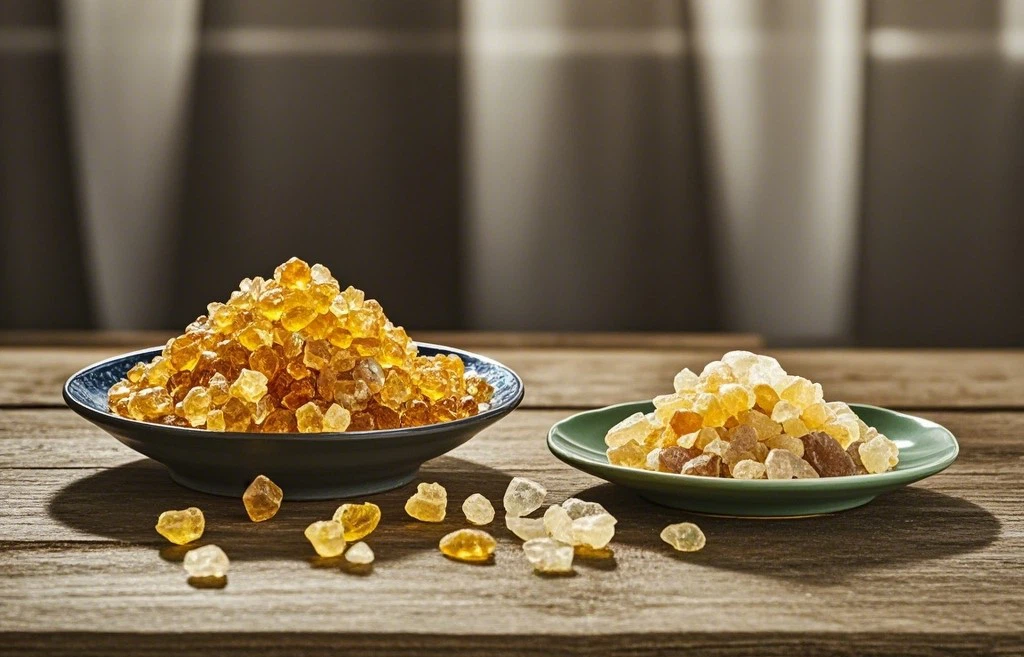
Gum arabic powder is usually a light yellow to light brown granular or powdery substance. It has good solubility and can quickly dissolve in water to form a viscous solution. Its viscosity is high and can vary over a wide range depending on the concentration. Generally speaking, the higher the concentration, the greater the viscosity. For example, in the food industry, a lower concentration of gum arabic is usually used to achieve a better thickening and stabilizing effect.
Mastic Gum is mostly a transparent or light yellow block or granular substance. It has relatively poor solubility in water, but has certain solubility in organic solvents such as ethanol. Mastic Gum has a relatively low viscosity, but it has unique viscosity and elasticity. In the field of art, this property makes it an ideal glazing agent and pigment binder.
(II) Chemical properties
The main chemical component of Arabic Gum is a complex of polysaccharides and proteins. It contains a large amount of sugar substances such as arabinose and galactose, as well as a small amount of protein and minerals. Due to its complex chemical structure, gum arabic can react chemically with other substances under certain conditions. For example, it can form complexes with metal ions, affecting its stability in food and medicine.
The main components of Mastic Gum are resin acids, terpenoids and volatile oils. Its chemical composition is relatively complex, and the resin acids have a certain acidity and can react with alkali to neutralize. In addition, the volatile oil components in Mastic Gum give it a unique aroma and taste.
(III) Differences in medicinal value
Arabic Gum is considered to have certain medicinal value in traditional medicine. It can be used as a laxative to promote intestinal peristalsis and relieve constipation. In addition, gum arabic also has certain hypoglycemic and hypolipidemic effects. However, when using gum arabic as a drug, attention should be paid to its dosage and safety. Excessive use may cause side effects such as gastrointestinal discomfort.
The medicinal value of Mastic Gum in traditional medicine is mainly reflected in its benefits to the digestive system. It is believed to relieve gastrointestinal inflammation and ulcers and promote gastrointestinal healing. Studies have shown that some components in Mastic Gum have antibacterial and anti-inflammatory effects and can inhibit the growth of harmful bacteria such as Helicobacter pylori. At the same time, Mastic Gum also has a certain antioxidant effect, which can help the body resist the damage of free radicals. However, the medicinal value of Mastic Gum still needs more clinical research to confirm. When using Mastic Gum as a medicine, you also need to pay attention to its safety and side effects. Some people may be allergic to Mastic Gum and may experience allergic reactions such as rashes and itching after use. In addition, long-term and large-scale use of Mastic Gum may also burden organs such as the liver and kidneys.
Summary And overview of the features
(1)Arabic Gum and Mastic Gum exhibit characteristics, across aspects.
Gum arabic powder is primarily sourced from trees, like acacia trees and Senegalese acacia in Africa with Sudan being its producer, at around 70% of the output share. On the hand Mastic Gum is derived from the Pistacia tree that produces frankincense in the Mediterranean region primarily found on the island of Kaeo.
In industries applications; Arabic Gum serves as a stabilizer and adhesive, in drinks, candies and dairy products within the food industry. Meanwhile Mastic Gum finds usage in specialty foods in quantities. Within the cosmetics sector Arabic Gum. Emulsifies while providing moisture. On the hand Mastic Gum boasts richness alongside antioxidant and antibacterial properties making it a key ingredient, in luxury skincare products. In the field of pharmaceuticals Arabic Gum is commonly used as an suspending agent. Mastic Gum could potentially offer benefits, for digestive health although further studies are required to confirm its efficacy.
When looking at the features of Gum and Mastic Gum from a standpoint. Arabic Gum appears as light yellow, to light brown granules or powders that dissolve easily in water and have high viscosity while Mastic Gum is mainly transparent or light yellow blocks or granules that are not very soluble in water but somewhat soluble, in ethanol and have a distinct viscosity and elasticity. Arabic Gum is primarily composed of polysaccharides and proteins that include sugars, like arabinose and galactose along with a presence of proteins and minerals whereas Mastic Gum consists of resin acids, alongside terpenoids and volatile oils. When it comes to its healing properties Arabic Gum can act as a laxative. Help lower blood sugar and blood lipids. However overusing it can lead to side effects. Mastic Gum is good, for the system with its anti inflammatory and antioxidant properties.. Remember to be cautious, about its safety and potential side effects when using it.
(2)Prospects, for Future Growth and Development
In the coming years aheads Arabic Gum and Mastic Gum show promise, for growth, across a range of areas.
In the food sector today amidst a rising interest, from consumers in nutritious food options Arabic Gum is projected to see use as a natural food enhancer. Simultaneously further exploration into the uses of Mastic Gum in food products could introduce concepts, for crafting specialty foods.
In the beauty industry sector; the ongoing expansion of the skincare market is set to open up avenues, for these two substances. Arabic Gum with its thickening and moisturizing properties and Mastic Gum known for its antioxidant qualities as well, as anti inflammatory and antibacterial benefits; making them increasingly appealing to cosmetic producers.
The pharmaceutical sector is still, in the process of investigating and clinically validating the use of Mastic Gum for purposes; however its potential benefits are worth exploring as research, into remedies advances further.Arabic Gum will also retain its significance in formulations by enhancing drug stability and bioavailability.
In summary, Gum arabic powder and Mastic Gum are two materials distinguished by their characteristics and applications that hold promise for future advancements, in various sectors, as research and creativity drive continued exploration into their potential benefits and versatility.
JOYWIN founded in 2013 is an innovation-driven biotechnology company. We provide the manufacture of plant extracts, plant proteases, and customized products. If you want to know more about Gum Arabic powder or are interested in purchasing it, you can send an email to contact@joywinworld.com. We will reply to you as soon as possible after we see the message.