



Vitamin B12, also known as cobalamin, is a powerhouse nutrient that plays an essential role in nearly every aspect of our health. From energizing our bodies and building DNA to protecting our nerves and forming red blood cells, this water-soluble vitamin is non-negotiable for human well-being. Yet, despite its critical importance, Vitamin B12 deficiency is one of the most common nutritional deficiencies worldwide, affecting people of all ages and diets.
For manufacturers and formulators in the dietary supplement industry, understanding the nuances of this vitamin is key to creating effective products. And for the consumers you serve, navigating the world of B12 supplementation can be confusing. This comprehensive Vitamin B12 FAQ is designed to answer the most pressing questions, cut through the complexity, and highlight why sourcing high-quality Pure B12 Powder is fundamental to product success.
At Joywin Naturals, we understand that the efficacy of a supplement begins with the purity and quality of its raw ingredients. Since our founding in 2013, we have built a reputation as an innovation-driven biotechnology company, recognized globally for our manufacturing excellence in natural products. While we are best known as the world's largest manufacturer of organic inulin and one of the top four bromelain producers globally, our commitment to stringent quality control-backed by certifications including cGMP, BRC, FSSC, Kosher, HALAL, ISO9001, ISO14001, and ISO22000-extends to every ingredient we handle. This dedication ensures that when you source ingredients with us, you are building your formulations on a foundation of integrity, technology, and quality.
Let's dive into the most frequently asked questions about Vitamin B12.
Section 1: The Basics – What is Vitamin B12?
Q1: What exactly is Vitamin B12 and why is it so important?
A: Vitamin B12 is the largest and most structurally complex of all the vitamins. It is unique because it contains the essential mineral cobalt, which is why B12 compounds are called "cobalamins." This vitamin is a crucial cofactor for two important enzymatic reactions in the human body:
1.Methionine Synthase Reaction: This reaction is vital for the conversion of homocysteine to methionine. Methionine is an essential amino acid needed to create S-adenosylmethionine (SAMe) , a universal methyl donor involved in the synthesis of DNA, proteins, and neurotransmitters. Failure of this reaction leads to a buildup of homocysteine, a risk factor for cardiovascular disease.
2.L-methylmalonyl-CoA Mutase Reaction: This reaction is essential for the metabolism of certain fats and amino acids into energy. A deficiency here leads to a buildup of methylmalonic acid (MMA), which is toxic to nerve cells.
In simpler terms, without enough Vitamin B12, your body cannot:
* Produce healthy red blood cells (leading to anemia).
* Maintain the protective myelin sheath around your nerves (leading to neurological issues).
* Properly synthesize DNA.
* Convert food into usable energy efficiently.
Q2: What are the different forms of Vitamin B12 found in supplements?
A: When formulating with Pure B12 Powder, it is essential to understand that not all B12 is the same. The two primary forms used in supplements are:
1.Cyanocobalamin: This is the most common, stable, and cost-effective synthetic form of B12. The body must convert cyanocobalamin into the active forms (methylcobalamin or adenosylcobalamin) by removing the cyanide molecule. It is highly stable and has a good shelf life, making it a popular choice for many supplements and fortified foods.
2.Methylcobalamin: This is one of the two naturally occurring, active forms of B12 in the human body. It contains a methyl group and is directly usable for the methionine synthase reaction, crucial for methylation and homocysteine reduction. It is often preferred for neurological support.
3.Adenosylcobalamin: This is the other naturally occurring, active form, primarily stored in the mitochondria of cells (like the liver and muscles). It is the essential cofactor for the L-methylmalonyl-CoA mutase reaction, critical for energy metabolism.
4.Hydroxocobalamin: This is a natural form produced by bacteria and is a precursor to methylcobalamin and adenosylcobalamin. It is often used in injectable forms due to its long-lasting effects in the body.
For formulators, choosing between these depends on the target application and cost. B12 Powder is available in all these forms, allowing you to create specialized blends.
Section 2: Deficiency – Who is at Risk and What are the Signs?
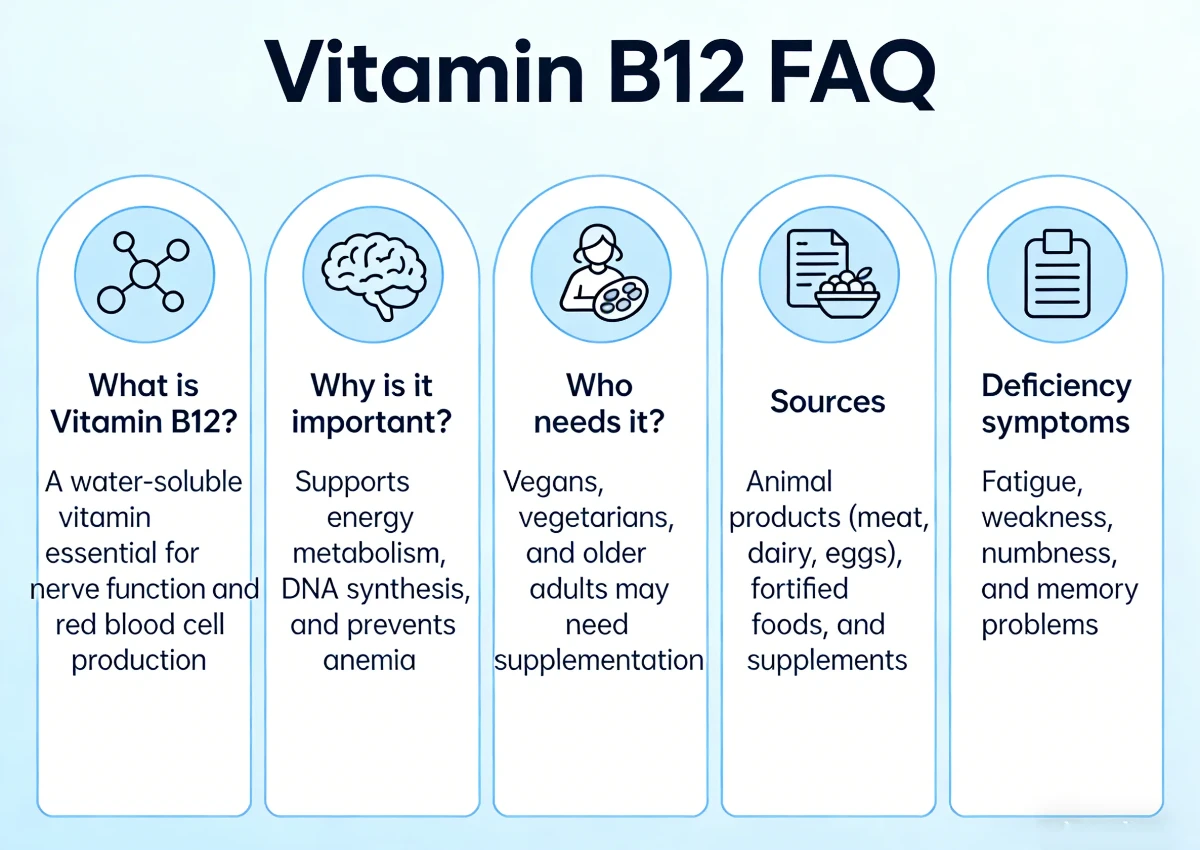
Q3: Who is most at risk for Vitamin B12 deficiency?
A: Deficiency can affect anyone, but certain populations are at significantly higher risk due to dietary choices or physiological factors.
* Vegans and Vegetarians: This is the most well-known risk group. Vitamin B12 is naturally found almost exclusively in animal products (meat, fish, eggs, dairy). Plant foods do not contain B12 unless they are fortified. Therefore, individuals following strict plant-based diets must supplement.
* Older Adults (50+): As we age, our stomachs produce less acid. Stomach acid is essential for extracting B12 from food proteins. Up to 30% of older adults may have atrophic gastritis, which severely impairs their ability to absorb food-bound B12. The Institute of Medicine recommends that adults over 50 meet their B12 needs mainly from supplements or fortified foods, as the crystalline form in supplements is absorbed independently of stomach acid.
* Individuals with Gastrointestinal Disorders: Conditions like Crohn's disease, celiac disease, and atrophic gastritis damage the lining of the stomach or small intestine, where B12 is absorbed. Similarly, people who have undergone weight loss surgery (gastric bypass) are at high risk.
* People Taking Certain Medications: Long-term use of proton pump inhibitors (PPIs) for acid reflux and the diabetes drug metformin can interfere with B12 absorption.
* Pernicious Anemia Sufferers: This is an autoimmune condition where the body attacks intrinsic factor (IF), a protein made in the stomach that is absolutely required for B12 absorption in the small intestine.
Q4: What are the common symptoms of Vitamin B12 deficiency?
A: The symptoms of B12 deficiency can be subtle at first but can become severe over time. They are broadly categorized into physical and neurological symptoms.
Physical Symptoms:
* Fatigue, weakness, and lethargy (due to anemia)
* Pale or jaundiced (yellowish) skin
* Shortness of breath and heart palpitations
* Glossitis (a smooth, red, swollen tongue) and mouth ulcers
Neurological Symptoms (can occur with or without anemia):
* Numbness or tingling (paresthesia) in the hands and feet (peripheral neuropathy)
* Balance problems and difficulty walking (ataxia)
* Memory loss, confusion, and difficulty thinking or concentrating ("brain fog")
* Mood changes, such as depression or irritability
* Visual disturbances (due to optic nerve damage)
Because neurological symptoms can be permanent if the deficiency is prolonged, early detection and treatment with high-quality Pure B12 Powder or other forms is critical.
Section 3: Supplementation – Forms, Dosage, and What to Choose
Q5: What is the best form of Vitamin B12 to take: cyanocobalamin or methylcobalamin?
A: This is one of the most debated questions in the B12 world. The "best" form depends on the specific needs of the target consumer.
Cyanocobalamin:
* Pros: It is the most stable, has the longest shelf life, and is the most cost-effective to produce. It has a strong track record of effectively reversing deficiency and treating anemia. The body has a well-established pathway to convert it into the active forms.
* Cons: The body must convert it, which requires the removal of the cyanide molecule. While the amount is minuscule and poses no risk to healthy individuals, some people with specific genetic polymorphisms (like MTHFR) or kidney disease may prefer an active form to bypass the conversion step.
Methylcobalamin:
* Pros: It is the active form and is immediately usable by the body, particularly for neurological pathways and methylation. It is often preferred for supporting nerve health, mood, and cognitive function.
* Cons: It is less stable than cyanocobalamin and can degrade when exposed to light and heat over time. It is also more expensive. Some individuals may find methylcobalamin to be too stimulating, potentially causing anxiety or insomnia at high doses (though this is rare).
The Formulator's Choice: Many high-quality supplements now use a combination of methylcobalamin and adenosylcobalamin to provide both active forms, ensuring comprehensive support for both methylation and mitochondrial energy production. Others use cyanocobalamin for its stability and efficacy in general multivitamins. The key is to use B12 Powder from a trusted source to guarantee potency.
Q6: How much Vitamin B12 should I take daily? What is the correct dosage?
A: Dosage depends on the purpose of supplementation.
For General Health & Prevention:
* Recommended Dietary Allowance (RDA) for adults: 2.4 mcg per day.
* For pregnant women: 2.6 mcg per day.
* For breastfeeding women: 2.8 mcg per day.
* Standard supplement dose: Most multivitamins and B-complexes contain between 50 mcg and 500 mcg of B12. Because absorption efficiency drops as dosage increases, these higher amounts ensure that enough is absorbed to meet the body's needs.
For Treating Deficiency & Therapeutic Use:
Doses are significantly higher and are used to replete body stores.
* Oral supplementation: Doctors may prescribe or recommend 1,000 mcg to 2,000 mcg daily for a period of weeks to months. This high dose leverages passive diffusion (about 1-2% of the dose is absorbed without intrinsic factor), which is enough to correct a deficiency.
* Sublingual forms: These dissolve under the tongue, aiming for absorption directly into the bloodstream, bypassing the gut. They are popular, though studies show high-dose oral tablets are equally effective for most people.
* Injections: For severe deficiencies, or for those with pernicious anemia or malabsorption issues, intramuscular injections of hydroxocobalamin or cyanocobalamin are the most effective route.
Key Takeaway for Formulators: Offering Pure B12 Powder allows you to create products with a wide dosage range, from low-dose maintenance powders to high-potency therapeutic formulas. The slightly sweet, palatable taste of many B12 powders also makes them ideal for direct-to-consumer mixes.
Q7: Is it safe to take high doses of Vitamin B12?
A: Yes, Vitamin B12 has an exceptionally high safety profile. It is a water-soluble vitamin, meaning any excess that the body does not use or store is typically excreted in urine. There is no established Tolerable Upper Intake Level (UL) for B12 because it is considered non-toxic, even at very high doses. Side effects are extremely rare but can include mild acne or rosacea in susceptible individuals.
Section 4: Sourcing and Formulating with Pure B12 Powder
Q8: Why is sourcing high-quality B12 Powder important for supplement manufacturers?
A: The quality of your finished product is directly determined by the quality of your raw ingredients. Using substandard B12 Powder can lead to several problems:
1.Potency Issues: B12 is a delicate molecule. Poor manufacturing, handling, or storage can degrade the active ingredient, leading to a final product that does not contain the labeled amount. This results in ineffective supplements and unhappy customers.
2.Purity and Contaminants: Low-quality powders may contain impurities, residual solvents, or heavy metals, posing a safety risk and potentially failing regulatory compliance.
3.Stability Problems: The form of B12 and the quality of the raw material affect its stability in the final formulation. A poor-quality powder may degrade rapidly, shortening the product's shelf life.
Q9: What should B2B buyers look for in a supplier of Pure B12 Powder?
A: Choosing the right supplier is a critical business decision. Based on the standards we uphold at Joywin Naturals, here are key factors to consider:
* Manufacturing Certifications: Look for suppliers with internationally recognized certifications. These are third-party audits that verify the supplier's commitment to quality and safety.
- cGMP (Current Good Manufacturing Practices): Ensures products are consistently produced and controlled according to quality standards.
- BRC (British Retail Consortium) & FSSC (Food Safety System Certification): Global food safety standards that are highly regarded.
- ISO Certifications (9001, 14001, 22000): Demonstrate adherence to international standards for quality management, environmental management, and food safety management.
- Kosher and HALAL Certifications: Open up your products to broader markets.
* Traceability and Transparency: A reliable supplier can trace their raw materials back to the source and provide full transparency about their manufacturing process.
* Consistency and Stability Data: Request certificates of analysis (COAs) for each batch to verify potency and purity. Ask for stability studies to understand the product's shelf life.
* Technical Expertise: A good supplier should be able to advise on the best form of B12 for your specific application (e.g., methylcobalamin for a neurological health powder) and offer guidance on formulation.
At Joywin Naturals, our entire operation is built on these principles. Our decade of experience, our status as a leading global manufacturer, and our comprehensive suite of certifications are a testament to our commitment to providing ingredients you can trust.
Section 5: The Future of B12 in the Supplement Market
Q10: What are the emerging trends in Vitamin B12 supplementation?
A: The market for B12 is evolving alongside consumer preferences and scientific understanding.
1.Rise of Active Forms: There is growing consumer demand for "bioidentical" or active forms like methylcobalamin and adenosylcobalamin, driven by interest in personalized medicine and methylation support.
2.Combination Products: B12 is increasingly being incorporated into targeted formulations. Examples include:
* Energy & Metabolism Complexes: Paired with B6, iron, and coenzyme Q10.
* Brain Health & Mood Formulas: Combined with methylfolate, phosphatidylserine, and omega-3s.
* Vegan-Friendly Powders: Plant-based protein powders fortified with active B12.
3.Innovative Delivery Formats: Beyond tablets and capsules, consumers are drawn to convenient and enjoyable formats. This creates a huge opportunity for B12 Powder to be used in:
* Single-serve stick packs that can be mixed into water.
* Effervescent tablets.
* Oral sprays and drops.
* Gummies (though manufacturing B12 gummies requires careful attention to stability).
4.Focus on Plant-Based and Clean Label: As the global vegan and vegetarian population grows, so does the demand for high-quality, non-animal-derived B12 supplements. Clean label products with minimal excipients are highly sought after.
Conclusion: Your Trusted Partner for Pure B12 Powder and Beyond
Vitamin B12 is, and will continue to be, a cornerstone of the nutritional supplement industry. Its critical roles in energy, nerve health, and DNA synthesis make it indispensable. Understanding the nuances of its forms, dosage, and applications-and effectively communicating these to consumers through an FAQ format-builds trust and authority.
For supplement manufacturers, the path to creating effective, market-leading B12 products begins with sourcing ingredients of unparalleled purity and quality. You need a partner who not only provides B12 Powder but also brings technical expertise, rigorous quality control, and a commitment to integrity.
Since 2013, Joywin Naturals has been at the forefront of the natural ingredients industry. While we are globally recognized as the largest manufacturer of organic inulin and one of the top four bromelain producers, our capabilities extend to providing a wide range of high-quality raw materials, including specialized ingredients like B12 Powder. Our state-of-the-art facilities, adherence to cGMP standards, and a full portfolio of certifications (BRC, FSSC, Kosher, HALAL, ISO) ensure that every ingredient we supply meets the highest global standards for purity, potency, and safety. If you want to know more about Pure B12 Powder or are interested in purchasing it, you can send an email to contact@joywinworld.com. We will reply to you as soon as possible after we see the message.