

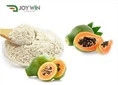
In the competitive landscape of dietary supplement ingredients, papain powder stands out as a powerhouse of natural enzymatic activity. This proteolytic enzyme, derived from the humble papaya (Carica papaya), is a cornerstone in formulations for digestive health, anti-inflammatory support, and protein processing. However, not all papain is created equal. The journey from the milky latex of a green papaya to a stable, high-potency powder is a precise science that directly dictates the ingredient's final efficacy, purity, and market value. For businesses seeking a reliable supply, understanding this process is not just academic-it's critical to securing a product that performs consistently in your applications.
This definitive guide will explore the sophisticated world of papain extraction. We will move beyond basic methods to examine the advanced technologies that separate industrial-grade ingredients from premium, nutraceutical-quality papain powder. By delving into the science of collection, separation, and purification, this article will equip you with the knowledge to evaluate suppliers, understand specifications, and make informed decisions for your product line. Welcome to the intricate art and science of harnessing nature's enzymatic power.
Chapter 1: The Source – Understanding Papain's Biological Origin
Papain is not simply "from papaya"; it is a specific defense molecule produced by the plant. Its extraction begins with a deep understanding of its source.
The Latex: A Plant's Defense System
Papain is concentrated in the milky latex (a colloidal suspension) of the papaya tree. This latex flows through specialized vessels called laticifers and serves as the plant's protective mechanism against insects and herbivores due to its protein-digesting properties . The highest concentration of papain is found in the immature, green fruit, typically 70-100 days after fruit set, when this defensive system is most active . Significant amounts can also be found in the leaves, petioles, and even the trunk, though these are less commercially exploited .
A Complex of Enzymes
It's vital to recognize that "papain" often refers to the crude enzyme complex from latex. This complex primarily includes:
* Papain (the namesake enzyme, ~10% of soluble protein)
* Chymopapain (the most abundant, ~45%)
* Papaya peptidase
* Lysozyme
The goal of advanced extraction is to isolate and standardize the desired enzymatic activity from this mixture.
Chapter 2: The Foundation – Traditional Collection & Drying Methods
The initial step is the careful harvesting of the raw latex.
1. Field Tapping: An Artisanal Skill
Tapping is a delicate manual process. Using stainless steel blades or bamboo splinters, harvesters make 2-4 shallow, longitudinal incisions (about 0.3 cm deep) on the skin of the green fruit, from stalk to tip. The milky white latex oozes out and is collected in non-reactive containers like glass, stainless steel, or areca nut spathes. This process is typically done in the early morning for optimal latex flow and can be repeated on the same fruit at 3-4 day intervals.
2. Initial Preservation and Crude Drying
Fresh latex is highly perishable. Immediately after collection, a stabilizer like potassium metabisulfite is often added to prevent microbial growth and oxidative browning, which can destroy enzyme activity.
The most basic commercial product is made by simply drying this stabilized latex.
* Direct (Hot-Air) Drying: The latex is spread thinly and dried in ovens or even sunlight at 50-55°C. This yields a crude, brownish cake or powder with variable, often low, enzyme activity (approximately 600,000 - 800,000 units/gram) and higher microbial load. While simple and low-cost, this method is largely inadequate for high-grade nutraceutical applications due to impurities and heat-induced activity loss.
Table: Comparison of Basic Drying Methods for Crude Papain
|
Method |
Process |
Product Quality |
Typical Enzyme Activity |
Best For |
|
Direct Hot-Air Drying |
Latex dried as-is at 50-55°C |
Low; dark color, high impurities, variable stability |
~600,000 - 800,000 u/g |
Low-cost industrial applications (e.g., leather tanning) |
|
Spray Drying |
Latex is centrifuged, then atomized into hot air |
Moderate; lighter color, better solubility than direct drying |
~1,000,000 u/g |
Mid-grade food processing and brewing |

Chapter 3: The Modern Standard – Industrial Extraction and Refinement
To achieve the purity, potency, and safety required for dietary supplements, sophisticated multi-stage processing is essential.
The Core Refinement Process Flow
A modern, industrial-scale papain extraction facility follows a meticulous cold-process pathway to preserve enzyme integrity:
1. Raw Material & Pre-treatment: Fresh papaya pulp or concentrated latex is used. Antioxidants (e.g., vitamin C) and metal chelators (e.g., EDTA) are added to protect the enzyme's crucial sulfhydryl (-SH) groups from oxidation.
2. Grinding & Extraction: The material is finely ground in a colloid mill to maximize enzyme release into the aqueous phase.
3. Heat Exchange & Temperature Control: The slurry is instantly cooled to 8-12°C via a plate heat exchanger. Maintaining a low temperature throughout the subsequent steps is paramount to preventing activity loss.
4. Solid-Liquid Separation: A two-stage centrifugation process (e.g., disc centrifuge followed by a tubular bowl centrifuge) removes fibrous pulp, insoluble solids, and other coarse impurities, yielding a clarified liquid.
5. Microfiltration & Ultrafiltration: This is a critical purification stage. The clarified liquid passes through membrane systems:
* Microfiltration removes fine particles and microbes.
* Ultrafiltration concentrates the enzyme solution by removing water, salts, and small molecular-weight impurities, dramatically increasing purity and specific activity.
6. Final Drying – The Pinnacle of Quality: The concentrated enzyme solution undergoes vacuum freeze-drying (lyophilization). The solution is frozen, and the ice is sublimated under a vacuum. This low-temperature process is ideal for heat-sensitive enzymes, resulting in a high-porosity, soluble powder with minimal activity loss and superior stability.
Advanced Separation Technologies
Beyond filtration, research continues into more selective purification methods:
* Aqueous Two-Phase Extraction (ATPE): This elegant method uses systems like polyethylene glycol (PEG) and salt to create two immiscible aqueous phases. Papain partitions preferentially into one phase, separating from contaminants. Research shows systems like PEG/potassium phosphate offer high partition coefficients and purity.
* Chromatography: For the highest purity (e.g., for research or pharmaceutical use), techniques like ion-exchange or affinity chromatography are used, though they are less common for commercial-scale nutraceutical powder due to cost.
Chapter 4: Quality, Specification, and Analysis – The Buyer's Checklist
For a B2B buyer, understanding quality parameters is non-negotiable. Here's what defines premium papain powder.
1. Enzyme Activity (Potency)
This is the primary measure of value. Activity is measured in USP units/mg or similar, quantifying the enzyme's ability to hydrolyze a standardized protein substrate under defined conditions.
* Crude Papain: 600,000 - 1,000,000 u/g
* Refined Papain: 1,500,000 - 2,000,000 u/g
* High-Purity/Pharmaceutical Grade: Can exceed 3,000,000 u/g
2. Key Physical & Chemical Specifications
* Appearance: Off-white to light tan, free-flowing powder. Darker colors suggest overheating or impurities.
* Solubility: Should be readily soluble in water, forming a slightly opalescent solution.
* pH & Temperature Profile: Optimal activity at pH 6.0-7.0 and 55-65°C, though it retains activity across a broad range.
* Heavy Metals & Microbiology: Must comply with stringent limits (Pb, As, Hg, Cd) and have low total plate count, yeast, mold, and absence of pathogens like E. coli and Salmonella.
Table: Specification Comparison for Different Papain Grades
|
Parameter |
Food Grade (Spray-Dried) |
Nutraceutical Grade (Membrane+Freeze-Dried) |
Test Method/Note |
|
Activity (u/g) |
1,000,000 - 1,500,000 |
1,800,000 - 3,000,000+ |
USP / FCC |
|
Color |
Tan |
Off-white to cream |
Visual / Lab |
|
Solubility |
Good |
Excellent, fast-dispersing |
10% solution in water |
|
Loss on Drying |
<6% |
<5% |
Gravimetric |
|
Total Plate Count |
<50,000 CFU/g |
<10,000 CFU/g |
USP <61> |
|
Lead (Pb) |
<3 ppm |
<2 ppm |
ICP-MS |
Chapter 5: Applications and Sourcing – Connecting Process to Purpose
Diverse Industry Applications
The extraction method chosen dictates the application:
* Dietary Supplements (Digestive Aid, Anti-inflammatory): Requires high-purity, nutraceutical-grade powder from freeze-drying or advanced filtration. Consistency, potency, and low microbial counts are critical for capsule and tablet formulations.
* Food & Beverage (Meat Tenderizer, Brewing, Dairy): Uses refined spray-dried or filtered papain for clarity in beer (chill-proofing) or consistent tenderization.
* Cosmetics (Exfoliating Peels, Cleansers): Demands high-activity, skin-friendly grades with guaranteed purity.
* Industrial (Leather, Wool, Detergents): Often employs lower-cost, crude papain.
Sourcing with Expertise: A Guide for Buyers
When evaluating a papain powder supplier like JoyWin Natural, consider:
1.Process Transparency: Do they detail their extraction and drying methodology? Premium suppliers will highlight membrane filtration and freeze-drying.
2.Quality Documentation: Insist on comprehensive Certificates of Analysis (CoA) for each batch, showing activity, microbiology, and heavy metals.
3.Stability Data: Reputable suppliers conduct shelf-life studies to guarantee activity over time, often with recommended storage conditions (cool, dry, sealed).
4.Technical Support: Can they provide application-specific usage guidelines and compatibility data?
Frequently Asked Questions (FAQ)
Q1: What is the difference between papain from fruit latex and papain from leaves?
A: The enzyme is biochemically similar, but the concentration and yield are vastly higher in the latex of immature fruits, making it the primary commercial source. Leaf extraction is an area of research but is not currently scalable for high-grade powder production.
Q2: Why is freeze-drying better than spray-drying for papain?
A: Freeze-drying occurs at low temperatures through sublimation, causing minimal thermal denaturation of the delicate enzyme protein. Spray-drying exposes the enzyme to higher air temperatures, leading to greater activity loss. Freeze-dried powder also has better solubility and stability.
Q3: How does enzyme activity (u/g) translate to dosage in a finished supplement?
A: Dosage is based on active units, not weight. For example, if a capsule calls for 50,000 USP units of papain and your powder is rated at 2,000,000 u/g, you would use 0.025 grams (25 mg) of that powder per capsule. A higher-activity powder allows for smaller, more efficient dosages.
Q4: What are the key stabilizers used during extraction, and why are they important?
A: Chelators like EDTA bind to metal ions that can catalyze oxidation. Reducing agents like sulfite or cysteine protect the enzyme's active-site cysteine residue from oxidation, which would permanently inactivate it. Their use is a mark of a quality-conscious processor.
Q5: Can papain be considered vegan and allergen-free?
A: Papain is plant-derived and generally considered vegan. It is not a common allergen from a regulatory standpoint (not among the "major 9" food allergens). However, as with any protein, individual sensitivities can occur. Cross-contamination with allergens depends entirely on the facility's manufacturing practices, which should be verified with the supplier.
Conclusion: The Extraction Imperative
The question "How is papain extracted?" is, fundamentally, a question about quality, efficacy, and trust. The journey from a tropical fruit to a precision nutraceutical ingredient is a testament to food science and biochemical engineering. While traditional methods yield a basic commodity, it is the modern, controlled processes of cold extraction, membrane purification, and freeze-drying that unlock the consistent, high-potency papain powder demanded by today's advanced supplement formulations.
For brands committed to delivering proven results, partnering with a supplier who masters this intricate extraction process is the first and most crucial step. It ensures that the natural enzymatic power of the papaya is delivered intact, batch after batch, into the hands of the end consumer.
JOYWIN founded in 2013 is an innovation-driven biotechnology company. We provide the manufacture of plant extracts, plant proteases, and customized products. If you want to know more about Papain powder or are interested in purchasing it, you can send an email to contact@joywinworld.com. We will reply to you as soon as possible after we see the message.