

In the modern landscape of functional foods, few ingredients have achieved the ubiquity and versatility of Inulin Prebiotic Powder. Once viewed merely as a dietary fiber, inulin has evolved into a critical tool for the "Clean Label" movement, serving simultaneously as a prebiotic, a sugar reducer, a fat replacer, and a texture modifier.
For the B2B buyer and product developer, however, sourcing inulin is no longer a simple commodity transaction. The market is nuanced. Differences in raw material origin (Chicory vs. Jerusalem Artichoke vs. Agave), Degree of Polymerization (DP), and solubility profiles can drastically alter the outcome of a finished product.
This comprehensive guide is written for the industry professional. We move beyond basic health claims to explore the rheology, stability, and sourcing dynamics of inulin. Whether you are formulating a keto-friendly protein bar, a low-sugar beverage, or a synbiotic yogurt, this guide will ensure you select the precise specification of inulin powder required for success.
1. The Market Imperative: Why Inulin is the "Swiss Army Knife" of Ingredients
The global inulin market is projected to reach USD 1.5 billion by 2028, growing at a CAGR of roughly 6%. This growth is not accidental; it is driven by the convergence of three massive consumer trends:
The War on Sugar: With sugar taxes implementing globally and consumers scrutinizing "Added Sugars" on labels, manufacturers need bulking agents that provide sweetness without the glycemic spike.
The Gut Health Revolution: "Prebiotics" are the new "Probiotics." Consumers now understand that feeding their microbiome is as important as seeding it.
Plant-Based Texturizing: As gelatin and synthetic thickeners fall out of favor, plant-based fibers that mimic the mouthfeel of fat are in high demand.
For a brand owner, inulin powder is the answer to all three. It allows for claims like "High Fiber," "Reduced Sugar," and "Keto-Friendly" while improving the sensory profile of the product.
2. The Chemistry of Inulin: Understanding What You Are Buying
To formulate effectively, one must understand the molecule. Inulin is a heterogeneous collection of fructose polymers. It belongs to a class of dietary fibers known as fructans.
The Structure
Chemically, inulin consists of linear chains of fructose units linked by β(2→1) glycosidic bonds, typically terminating in a glucose unit.
Why this matters: The human digestive enzymes (alpha-amylase, sucrase, maltase) are designed to break alpha bonds, not beta bonds. Therefore, inulin passes through the small intestine undigested and arrives in the colon, where it is fermented by beneficial bacteria (Bifidobacteria and Lactobacilli).
The Critical Metric: Degree of Polymerization (DP)
When you buy Inulin Prebiotic Powder from Joywin Natural, the most important technical specification is the Degree of Polymerization (DP). This refers to the chain length of the fructose units.
Short-Chain Inulin (Oligofructose / FOS):
DP: < 10
Characteristics: Highly soluble, sweet (30-50% sweetness of sucrose), less viscous.
Best For: Sugar reduction in beverages, binding in cereals, humectant in soft baked goods.
Native Inulin (Standard):
DP: Average range of 10–25.
Characteristics: A balance of solubility and texture. Neutral taste with slight sweetness.
Best For: General supplementation, capsules, and powdered drink mixes.
Long-Chain Inulin (High Performance / HP):
DP: > 23 (often up to 60).
Characteristics: Low solubility, thermally stable, forms a gel when mixed with water (microcrystalline structure).
Best For: Fat replacement. It creates a creamy, fat-like mouthfeel in low-fat dairy, dressings, and spreads.
Formulator's Tip: If your supplier cannot tell you the average DP of their inulin, you are flying blind. A short-chain inulin will fail as a fat replacer (it won't gel), and a long-chain inulin will fail in a clear beverage (it will precipitate).
3. Sourcing Dynamics: Chicory vs. Jerusalem Artichoke vs. Agave
Historically, Chicory Root was the primary source of commercial inulin. However, supply chain volatility and geopolitical issues in Europe have forced buyers to diversify.
A. Chicory Root Inulin
Status: The industry standard.
Pros: Well-studied, neutral flavor.
Cons: Supply shortages are common; prices fluctuate wildly based on European harvest yields.
B. Jerusalem Artichoke Inulin powder (The Joywin Specialty)
Status: The rising star, particularly for Organic and Non-GMO projects.
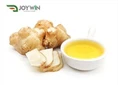
Source: Extracted from the tuber of Helianthus tuberosus.
Pros:
Sustainability: Jerusalem Artichoke is a robust crop that requires less water and pesticides than chicory.
Organic Availability: Easier to source certified organic tubers.
Efficacy: comparable prebiotic activity to chicory.
Cons: Can have a slightly earthier note if not processed correctly (Joywin uses advanced filtration to ensure a neutral profile).
C. Agave Inulin
Status: Popular in the US market due to the tequila industry connection.
Structure: Unlike Chicory/Jerusalem Artichoke (linear chains), Agave inulin is branched.
Pros: Highly soluble, even in cold water.
Cons: Ferments faster in the gut, which can lead to gas/bloating more quickly than linear inulins.
Buying Advice: For most solid dose supplements and functional foods, Jerusalem Artichoke Inulin offers the best balance of cost, sustainability, and supply chain security.
4. Functional Applications: How to Formulate with Inulin
This section details how to use Inulin Prebiotic Powder to solve specific R&D challenges.
Strategy 1: Sugar Reduction (The Bulking Agent)
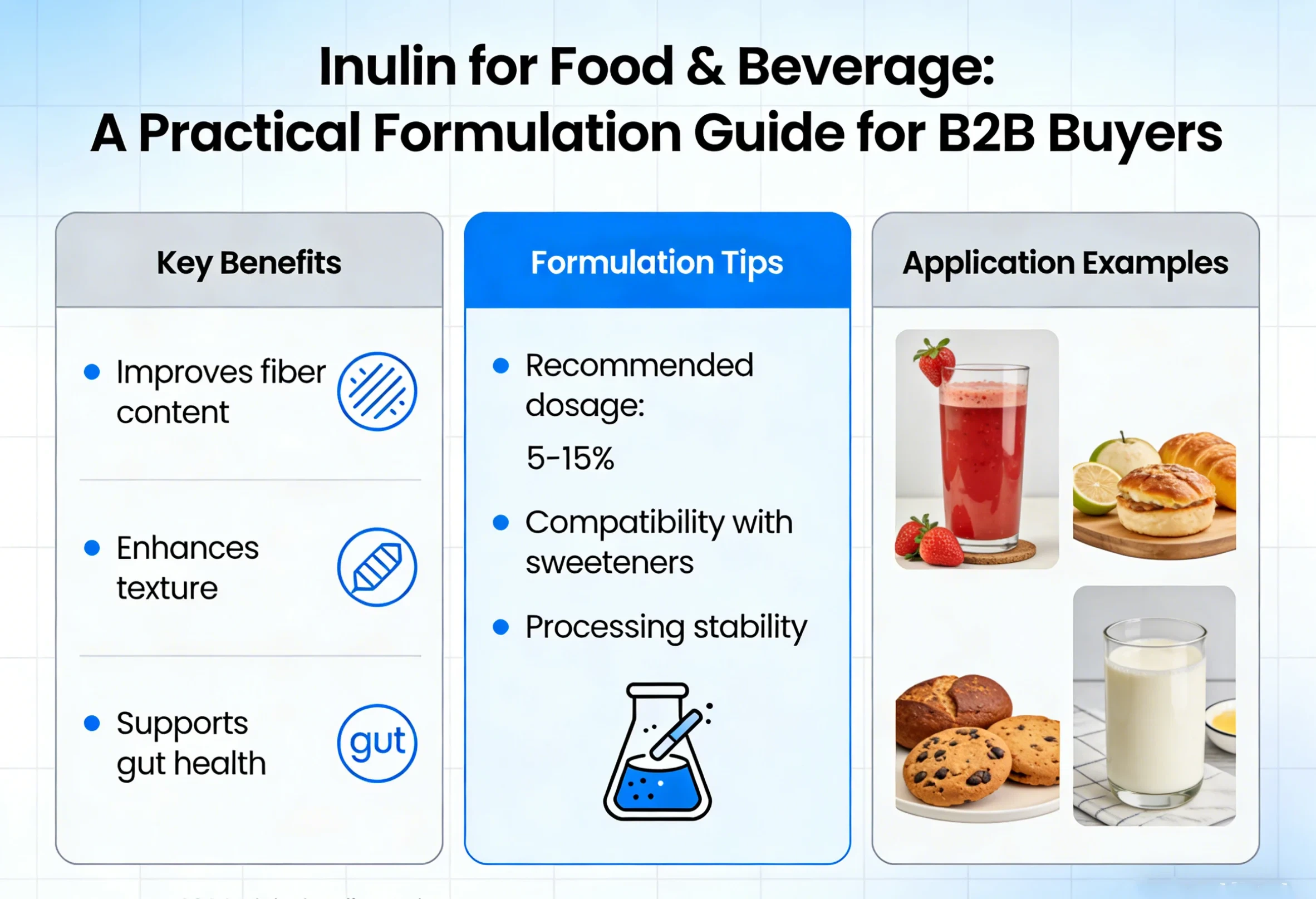
When you remove sugar (sucrose) from a recipe and replace it with a high-intensity sweetener like Stevia or Monk Fruit, you lose bulk. Stevia is 200x sweeter than sugar, so you only use a tiny amount. The result? A cookie that is flat or a beverage that feels "thin" (watery).
The Inulin Fix: Inulin provides the "body" that sugar used to provide.
Usage Rate: Replace sugar mass with inulin at a 1:1 ratio for bulk, then add high-intensity sweeteners to adjust sweetness.
Synergy: Inulin masks the metallic aftertaste often associated with Stevia.
Strategy 2: Fat Replacement (The Creaminess Factor)
In low-fat yogurts, ice creams, or dressings, removing fat ruins the mouthfeel.
The Inulin Fix: Long-chain inulin, when sheared with water, forms a particle gel network. These microcrystals roll over the tongue, mimicking the sensation of fat globules.
Usage Rate: 2% to 5% inulin can replace up to 30% of the fat in dairy applications without compromising texture.
Strategy 3: Texture Modification in Bars
Protein bars often harden over time ("bar hardening") due to protein migration.
The Inulin Fix: Short-chain inulin acts as a humectant (holds moisture). It keeps the bar soft and chewy over its shelf life.
Warning: Using too much can make the bar sticky. A blend of inulin and soluble corn fiber is often the "Goldilocks" solution.
5. The "Tolerance" Challenge: FODMAPs and Dosage
Honesty builds trust. The biggest hurdle for inulin is digestive tolerance. Because it is fermented rapidly in the colon, high doses can cause gas and bloating in sensitive individuals (high FODMAP).
How to mitigate this in your product:
Dosage Control: The general "No Observed Adverse Effect Level" (NOAEL) is around 10g-15g per day for most people. However, in a single serving, keep it under 5g to be safe.
Labeling: If your product contains >5g per serving, consider adding a "start slow" advisory on the package.
Chain Length: Long-chain inulin ferments slightly slower than short-chain (FOS), potentially reducing the "gas spike."
6. Manufacturing & Processing: Handling Inulin Prebiotic Powder
For the procurement manager and production lead, the physical properties of the powder matter as much as the chemistry.
Hygroscopicity (Clumping)
Inulin, especially short-chain versions (Oligofructose), is hygroscopic. It loves water.
The Problem: If you leave a bag open in a humid warehouse, it will turn into a brick.
The Joywin Solution: We utilize advanced spray-drying techniques and moisture-barrier packaging (aluminum foil liners) to ensure our inulin powder remains free-flowing.
Production Tip: Add inulin early in the mixing phase. If adding to liquids, use a high-shear mixer to prevent "fish eyes" (clumps of powder that are wet on the outside but dry on the inside).
Thermal Stability
pH Neutral: Inulin is heat stable. You can bake it in cookies or pasteurize it in beverages without degradation.
Acidic Environments: In highly acidic beverages (pH < 4.0), inulin can hydrolyze (break down) into fructose over time, especially if stored in hot conditions.
Result: You lose the fiber claim and gain sugar content.
Fix: For acidic beverages (like kombucha or sports drinks), shelf-life testing is mandatory to verify fiber stability.
7. Quality Assurance: The Joywin Natural Standard
As a B2B buyer, you are responsible for the safety of the end consumer. Here is the checklist you should apply to any inulin supplier.
1. Source Verification (C13/C12 Isotope Testing)
Adulteration is a risk. Unscrupulous suppliers may cut inulin with cheap maltodextrin or sucrose.
Joywin Protocol: We use Isotope Ratio Mass Spectrometry (IRMS) and HPLC fingerprinting to guarantee that our inulin is 100% derived from the specified plant source (Jerusalem Artichoke or Chicory).
2. Heavy Metals & Soil Health
Root crops absorb everything in the soil.
Joywin Protocol: We strictly monitor Lead (Pb), Arsenic (As), Cadmium (Cd), and Mercury (Hg). Our limits are often stricter than USP/EP standards (e.g., Lead < 0.5 ppm).
3. Organic Certification
The demand for "Organic Inulin" is outpacing supply.
Joywin Protocol: We hold NOP (USDA) and EU Organic certifications. We control the supply chain from the farm to the extraction facility, ensuring no cross-contamination with conventional pesticides.
8. Regulatory Landscape: Labeling Your Product
How you list inulin on the label affects your marketing.
USA (FDA): Inulin is recognized as a Dietary Fiber.
Benefit: You can count it towards the "Total Fiber" line on the Nutrition Facts panel.
Caloric Value: The FDA allows inulin to be calculated at 1.5 kcal/g (compared to 4 kcal/g for carbohydrates). This is a massive advantage for "Low Calorie" formulations.
Europe (EFSA): Recognized as a dietary fiber with a specific health claim available for "Native Chicory Inulin" regarding maintenance of normal defecation (requires 12g daily dosage).
Labeling Names: Can be listed as "Inulin," "Chicory Root Fiber," "Jerusalem Artichoke Fiber," or "Oligofructose" (if short chain). "Chicory Root Fiber" often tests better with consumers who want "natural" sounding ingredients.
Frequently Asked Questions (FAQ) for Formulators
Q: Can I use inulin in a clear beverage? A: Yes, but you must use a Short-Chain or Native Inulin with high solubility. Long-chain inulins may cause cloudiness or precipitation over time.
Q: Is Inulin Prebiotic Powder Keto-friendly? A: Yes. Inulin has a glycemic index of effectively zero. It does not spike blood sugar or insulin, making it perfect for Keto and Low-Carb products.
Q: What is the difference between Inulin and Psyllium Husk? A: Psyllium is a mechanical fiber (it gels and bulks stool physically). Inulin is a fermentable fiber (prebiotic). Inulin is completely soluble and invisible in products, whereas Psyllium adds a gritty texture and thickens rapidly.
Q: Does Joywin offer Organic Inulin? A: Yes, we are a leading supplier of Certified Organic Inulin derived from Jerusalem Artichoke.
Conclusion: The Future of Inulin
Inulin is no longer just a trend; it is a formulation staple. As the industry moves toward Synbiotics (combining Probiotics + Prebiotics) and personalized nutrition, the demand for high-quality, characterized inulin will only grow.
For the B2B buyer, the goal is to move beyond price-per-kg and look at cost-in-use. A cheap, clumpy inulin that slows down your production line or a generic inulin that fails to provide the right texture is not a bargain.
Joywin Natural stands at the intersection of nature and science. We don't just supply Inulin Prebiotic Powder; we provide the technical data, the stability testing, and the supply chain transparency you need to build a market-leading brand.
Ready to test the difference? Whether you need Organic Jerusalem Artichoke Inulin for a clean-label bar or high-performance Chicory Inulin for a beverage, we have the stock and the expertise. If you want to know more about it or are interested in purchasing it, you can send an email to contact@joywinworld.com. We will reply to you as soon as possible after we see the message.