

In the rapidly evolving world of dietary supplements and health-conscious food production, few ingredients have sparked as much debate as erythritol. As a supplier of high-quality botanical extracts and specialty ingredients, at Chongqing Joywin Natural Products Co., Ltd., we understand the critical importance of transparency and scientific accuracy for our B2B clients and their customers. A question we frequently encounter from formulators and brands is: "Is erythritol natural or artificial?"
The answer is not as straightforward as a simple label. It requires a journey through food science, natural history, human metabolism, and regulatory affairs. For manufacturers looking to formulate with pure erythritol powder, understanding its true nature is essential for accurate marketing, regulatory compliance, and building consumer trust.
In this comprehensive guide, we will explore the origins of erythritol, how it is made, its regulatory status, health benefits, and the latest scientific research, providing you with the authoritative knowledge you need.
What Exactly is Erythritol?
Before we can classify it, we must first understand what it is chemically. Erythritol is a type of carbohydrate called a sugar alcohol, or polyol . Other familiar sugar alcohols include xylitol, sorbitol, and maltitol. Despite the name, sugar alcohols are neither sugar nor alcohol. They do not contain the ethanol found in alcoholic beverages . Instead, their chemical structure allows them to stimulate the sweet taste receptors on our tongue, much like sugar does.
Erythritol is unique among sugar alcohols for several reasons:
* Caloric Content: It has virtually zero calories (about 0.2 calories per gram, compared to sugar's 4 calories per gram) .
* Sweetness: It is about 60-80% as sweet as table sugar (sucrose), making it a effective bulk sweetener .
* Molecular Size: It has a small molecular structure, which plays a key role in how it is digested and absorbed by the body .
The Case for "Natural": Where Does It Come From?
This is the most compelling part of erythritol's story. Unlike high-intensity artificial sweeteners such as aspartame or sucralose, which are synthesized entirely in a laboratory, erythritol has a long history in the natural world.
Naturally Occurring in Foods
Erythritol is not a modern invention; it is a compound found abundantly in nature. It is present in various fruits and fermented foods that humans have consumed for centuries .
* Fruits: It is found in melons, grapes, pears, and watermelon .
* Fungi and Mushrooms: It occurs naturally in some mushrooms .
* Fermented Foods: It is a byproduct of fermentation and is present in small amounts in beer, wine, sake, soy sauce, and cheese .
The fact that erythritol exists in these whole foods is a primary reason why many in the industry, and even some regulatory contexts, consider it to be natural. In fact, the Japanese were the first to approve erythritol for use as a food additive in 1990, recognizing its natural origins .
Produced by the Human Body
Remarkably, erythritol is also endogenous, meaning our own bodies produce it. It is created during normal glucose metabolism through a process called the pentose phosphate pathway . This means trace amounts of erythritol are naturally present in human blood and tissues, further blurring the line between what we consider "natural" and "synthetic" .
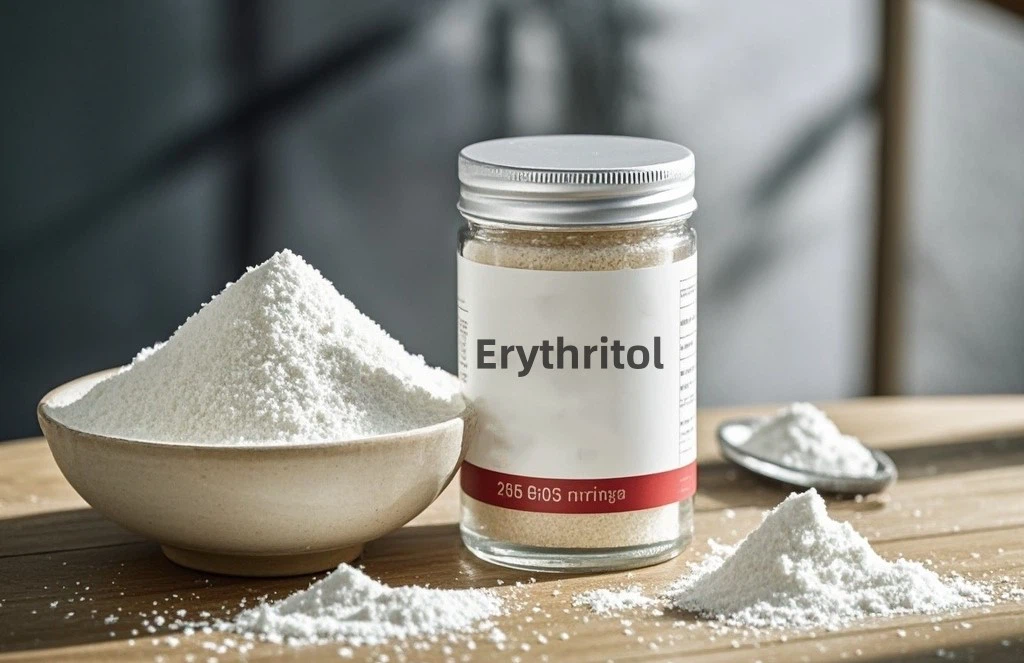
The Case for "Artificial": How is Commercial Pure Erythritol Powder Made?
While erythritol is found in nature, the quantity is minuscule. To use it as a bulk sweetener in keto baking mixes, sugar-free beverages, or protein powders, it must be produced on an industrial scale. This is where the "natural vs. artificial" debate gains complexity.
The vast majority of commercial erythritol powder is produced through a process that is best described as "nature-identical" or "bio-manufactured." It begins with a natural source and uses a natural process (fermentation) but is facilitated by modern technology .
Here is a step-by-step breakdown of the commercial production process:
1.Sourcing the Starting Material: The process typically begins with glucose (dextrose) derived from corn or wheat starch . This glucose is a natural sugar.
2.Fermentation: This glucose is then fermented using specific types of yeasts or other microorganisms, such as Moniliella pollinis . This is the same principle used to ferment grapes into wine or grains into beer-a process that is widely accepted as "natural."
3.Purification and Crystallization: After fermentation, the erythritol is separated from the fermented broth, purified, washed, and dried, resulting in the final product: white crystals or a fine erythritol powder .
So, is the process artificial? It involves a controlled manufacturing facility. But does it use artificial chemistry? No, it relies on a biological process (fermentation) that has existed for millennia. This is why many producers and brands, including those featured on industry platforms, confidently market erythritol as a "natural" sweetener .
The Regulatory Perspective: What Do the Authorities Say?
Regulatory definitions are often the most practical guide for businesses. When the U.S. Food and Drug Administration (FDA) or the World Health Organization (WHO) evaluates an ingredient, their classification carries immense weight for labeling and market access.
FDA and GRAS Status
The FDA does not have an official, codified definition for the term "natural" on food labels, which adds to the confusion . However, the FDA has a rigorous process for determining if a substance is safe to eat.
In 2001, the FDA affirmed that erythritol is Generally Recognized as Safe (GRAS) . Importantly, the FDA does not classify erythritol as an artificial sweetener or a high-intensity sweetener . It is treated as a food additive that has been determined safe by qualified experts.
Global Consensus
* JECFA (Joint FAO/WHO Expert Committee on Food Additives): This committee reviewed erythritol and assigned it an Acceptable Daily Intake (ADI) of "not specified," which is the highest safety rating it can give, indicating a very low risk for use as a food additive .
* Europe: The European Commission and the European Food Safety Authority (EFSA) have also issued positive scientific opinions and approved erythritol for use in foods .
* Global Reach: Erythritol is now approved for use in more than 60 countries, a testament to its international acceptance as a safe food ingredient .
This global regulatory harmony strongly supports the position that erythritol is a safe, approved ingredient, distinct from synthetic artificial sweeteners.
Health Benefits and Metabolic Profile
To establish true expertise and credibility, we must look beyond semantics to the physiological effects of pure erythritol powder. Its unique metabolic pathway is what makes it so valuable for modern dietary formulations.
Unique Digestive Fate
Unlike sugar, erythritol acts differently in the body:
1.Absorption: It is rapidly absorbed in the small intestine .
2.Metabolism: The human body lacks the enzymes to effectively break down erythritol .
3.Excretion: It is excreted unchanged primarily through urine .
This means erythritol travels through the body without being fully metabolized, which is the source of its key benefits.
Key Health Benefits for Consumers
For your B2B customers formulating products for health-conscious consumers, these benefits are powerful selling points:
* Blood Sugar and Insulin: Erythritol does not raise blood glucose or insulin levels, making it an excellent sugar substitute for people with diabetes or those following ketogenic or low-carb diets .
* Dental Health: It is non-cariogenic. Unlike sugar, it does not feed cavity-causing bacteria like Streptococcus mutans in the mouth. In fact, it may inhibit their growth and reduce dental plaque, which is why the FDA has recognized this benefit .
* Low Calorie: With near-zero calories, it helps in reducing the overall caloric load of food products .
* High Digestive Tolerance: Compared to other polyols like sorbitol and mannitol, erythritol is much better tolerated and does not require a laxative warning label on products in the U.S., as it is less likely to cause diarrhea when consumed in moderate amounts .
Addressing Recent Research and Safety Concerns with Authority
As a trusted supplier, Joywin Natural believes in addressing scientific developments transparently. In 2023 and 2024, studies published in high-profile journals like Nature Medicine and Arteriosclerosis, Thrombosis, and Vascular Biology brought attention to a potential association between erythritol and cardiovascular events .
Here is a balanced, expert perspective on this research, which is crucial for demonstrating credibility and helping your clients navigate the conversation.
What the Studies Observed
The research suggested that in individuals already at high risk for heart disease (e.g., those with obesity, diabetes, or high blood pressure), high levels of circulating erythritol in the blood were associated with an increased risk of blood clot formation. A subsequent small interventional study found that consuming 30 grams of erythritol caused a significant and sustained increase in blood levels and enhanced platelet reactivity in healthy volunteers .
Crucial Context and Counterpoints
As a supplier, we must provide the full context, as noted by regulatory experts and other scientists :
1. Association vs. Causation: The authors of the Nature Medicine study themselves stated, "by design, these studies can only show association and not causation" . The observational studies looked at people who already had high levels, which could be due to diet, but also because their bodies were producing more due to underlying health conditions like high blood sugar.
2. Dosage and Population: The study used a very high dose of 30 grams. This is far more than what a person would get from a single serving of a typical sugar-free product, though it is plausible in a day's intake for some high consumers . More importantly, the results should not be directly applied to a healthy population, as the study cohorts were older and had significant pre-existing health issues.
3. Conflicting Evidence: A different clinical study published in BMJ Nutrition, Prevention & Health in the same year found that supplementing the diet with 36 grams of erythritol per day for five weeks had no effect on arterial stiffness, suggesting it does not negatively affect the structure and function of the arterial wall .
The Balanced Conclusion for Industry Professionals
The current weight of evidence does not overturn the decades of safety data from global regulatory bodies like the FDA and WHO. However, it does warrant a prudent and informed approach. For your clients, this means:
* Transparency is Key: Formulators should be aware of the emerging science and be prepared to discuss it with informed consumers.
* Target Audience Matters: As one supplement brand advises, individuals with diabetes, obesity, cardiovascular disease, or kidney disorders, or those on anticoagulant medications, should consult with their physicians regarding erythritol consumption .
* Moderation: As with all ingredients, moderation remains a sound principle. Most people tolerate erythritol well, and it plays a valuable role in reducing sugar intake .
Applications of Pure Erythritol Powder in Food and Supplements
The functional properties of erythritol powder make it a versatile ingredient for product developers. It provides bulk and texture similar to sugar, with a clean, sweet taste and a noticeable cooling effect on the tongue (similar to mint). It is widely used in:
* Keto and Low-Carb Products: As a primary sweetener in baked goods, snacks, and desserts .
* Sugar-Free Beverages: To sweeten without adding calories or affecting blood sugar .
* Confectionery: In chocolates, chewing gum, and candies where it also supports dental health claims .
* Pharmaceuticals and Supplements: As an excipient in chewable tablets, powders, and syrups to improve palatability .
Conclusion: So, Is It Natural or Artificial?
Returning to our original question: Is erythritol natural or artificial?
The most accurate and authoritative answer is that pure erythritol powder is a nature-identical sweetener produced via modern fermentation. It is not an artificial sweetener in the traditional sense.
* It is "natural" in its origin, as it is found in common fruits and fermented foods, and even produced by the human body .
* It is "manufactured" using a fermentation process that starts with natural plant-based glucose, a method that mimics a natural biological process at scale .
* It is not classified as an artificial sweetener by the FDA or WHO, and it enjoys GRAS status and global regulatory approval based on decades of safety research .
For your business as a supplier, and for the brands you serve, erythritol represents a science-backed, metabolic-friendly alternative to sugar. At Joywin Natural, while our core expertise lies in botanicals like inulin and bromelain, we understand that the future of food formulation rests on a foundation of quality, integrity, and deep ingredient knowledge.
By understanding the complete story of erythritol-from the fruit to the fermentation tank to the final product-you can make informed decisions and confidently communicate with your customers. We hope this deep dive has provided the clarity and expertise needed to navigate the sweet world of pure erythritol powder.
JOYWIN founded in 2013 is an innovation-driven biotechnology company. We provide the manufacture of plant extracts, plant proteases, and customized products. If you want to know more about Pure Erythritol Powder or are interested in purchasing it, you can send an email to contact@joywinworld.com. We will reply to you as soon as possible after we see the message.